

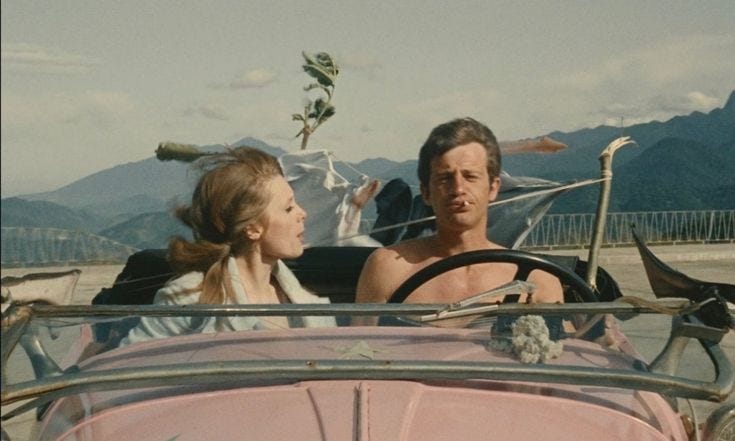
There is a strange understanding of travel as a cure -- a deliverance from our ordinary condition. I wonder it must be the dream of weary souls who believe they can escape the weight of their daily lives by boarding an airplane, weak and tired, and disembark completely reinvigorated. Travel has become this sort of yearly pilgrimage to distant lands, where the sunsets are more golden, the wine more intoxicating, where people live in a permanent state of euphoria. As if a that could magically free us from the burdens of our existence.
That is a seductive idea. Imagine someone who at home drinks coffee standing at a counter, looking at a screen in such a strange hurry -- the reason for which, they cannot quite justify. At eight o’clock in the fourth evening of a holiday that same person opens a bottle of wine, sits in a wobbly wooden chair, and spend a few hours appreciating the beauties life has to provide. They’ll find in that simple act a pleasure quite out of proportion to the wine they usually drink -- which they usually do not find very good.
What they are enjoying, I think, is not the wine -- it could be the same and they would not find the same pleasure in it had they been in their own home. It is the fact that the act of enjoyment is, for some inexplicable reason, impossible in their normal environment. That sort of attitude belongs to a different person, with different priorities, different cirmcumstances and different tastes. Strangely enough, for the next few days, being somewhere else, they allow themselves to be that person.
The escape people mean when they speak of getting away, I propose, is not an escape from a place necessarily. But rather an escape from themselves -- their usual selves. From the lives they've built and continue to maintain every morning. From the arrangements they abide by without recalling having agreed to, the tastes they have cultivated out of convenience, the pleasures they have by default filed under someday.
This is worth stating clearly, I think, because it almost never is, and the language we use largely prevents it from being stated. We don’t hear: I have arranged my existence badly and must, therefore, leave it periodically in order to tolerate it. We hear: I need a holiday. The second sentence is the first euphemised.
The abuse is not to travelling itself, of course. It is the contemporary moral inflation of travel. That same person, will come back from the Caribbean and tell you that the sea reenergised them. It did no such thing, or at least it wasn’t the sea! They only avoided thinking about their problems for a fortnight. They spent time being leisurely and allowed themselves to enjoy a few pleasures they’re usually denied.
Any of this would have been available to them at home -- at considerably less expense, had they believed they were permitted it. But we do not think we are permited, do we?! This is our actual condition. Unfortunately the fortnight does not resolve it; it merely conceals it -- marvellously, I must say. The pleasure is not in the thing necessarily but in the licence; and a pleasure that consists in licence points something out about the condition it has been licensed from.
I want to be careful here, because there is a version of this argument that ends in a kind of joylessness I have no interest in. Put me before a wall of sun-bleached stone, an old foldable wooden table that shakes, a good view in front of me and my critical faculties fold up like the table. I consider the ease with which we can travel nowadays one of the greatest victories of mankind.
I am not against travel. I am against the idea that travelling is the reward for the hardships one suffers through the everyday. That one needs holidays in order to endure the other part of their lives -- which is most of it, by the way. It’s the premise underneath it I can’t agree with. That bargain we so easily honour. A life mostly endured, in exchange for a few moments of reprieve every once in a while is, I think, nothing but poor existence. It would be a pity to live for something that can only occasionally be achieved.
My argument is not to travel because one must, but because one desires to -- not to escape from a life one has build poorly, but to enhance it. Travel for reasons more noble than escaping. Travel to see, to trade, to learn a craft, to fall unwisely in love, to learn a language, or to explore hte world.
So go south. I am hardly in a position to advise otherwise. Get burnt, eat too much, order the wrong drink, go for walks with no destination, appreciate the beauties of architecture, make friends and talk to strangers.
Because the question, clearly, is not whether you can be happy for a fortnight days in a warm coastal town in the summer. Anyone can do that, and the coast does most of the work, if you ask me. The question is Tuesday. An unremarkable Tuesday in February, in the climate you actually live in, with the work you actually have -- whether there is an hour in it for you, whether you can sit with whatever view you have, under whatever sun is or isn't available, and find a similar clarity; whether the day can be looked at directly rather than pushed through on borrowed philosophy.
If it can, travel will be a pleasure, and you will not need it.
If it cannot, no amount of leaving will help, but you already know this...
Emerson said something like the traveler carries ruins to ruins.
Always has stuck with me. It feels true, at least of myself.
Thanks for writing this.
Dang this is good.